July 30, 2012

2 More Woodchucks, 2 New Skunks

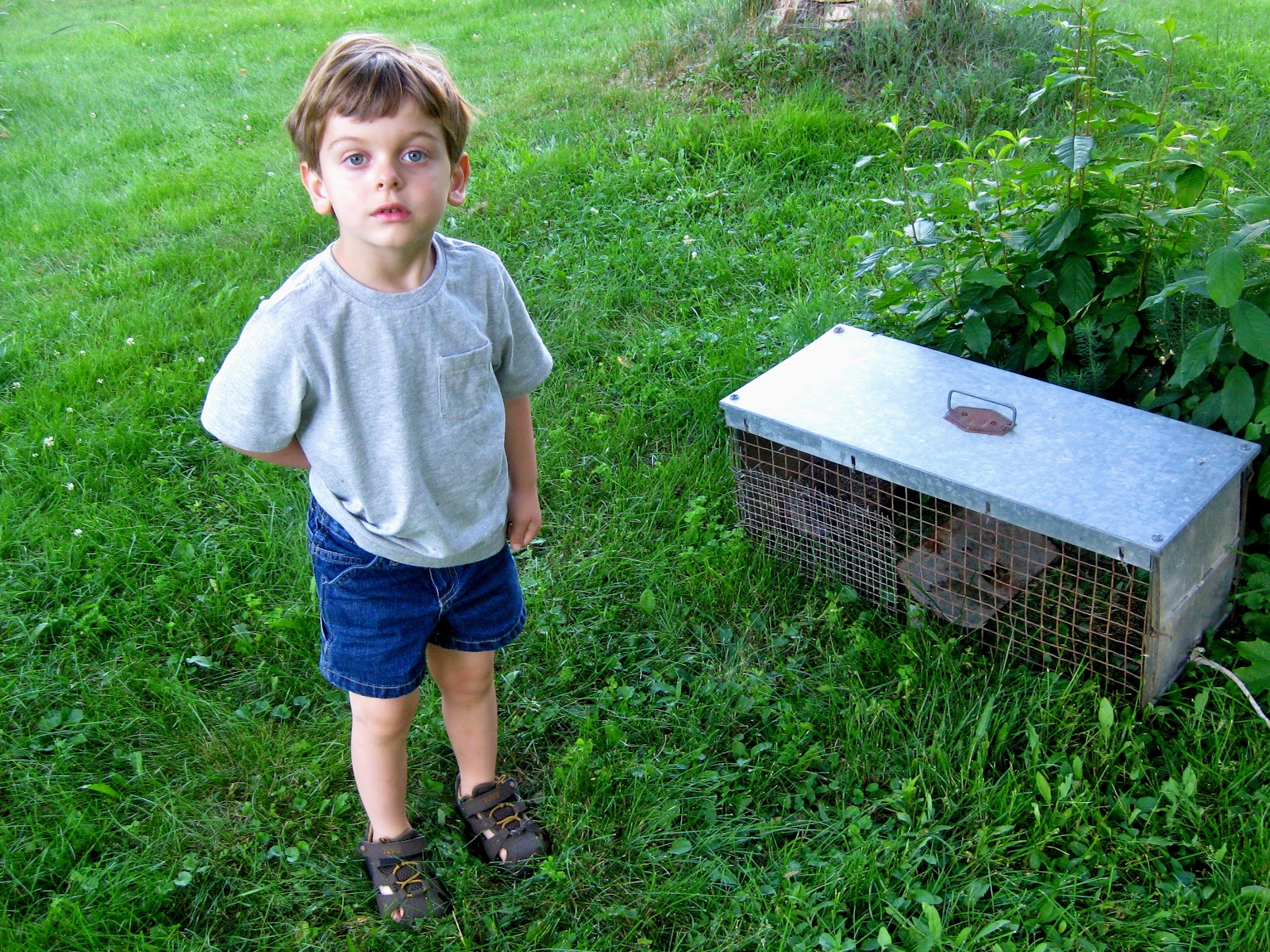
 Varmints in our traps are like Christmas in the summer. Every morning, Alden and I come downstairs to look out the kitchen window and see what we have caught. Since the last reportage, we've caught two groundhogs and two baby skunks.


July 15, 2012

First Honey Harvest

We harvested our first batch of honey this weekend (only a year and 3 months in the making)!  Our bee books and google tell us that there are three methods of removing bees from honey frames; 1) a fume board, which drives them out of the top box into the deeper supers, 2) an escape board, which uses mesh and a maze-like set up to allow bees to move down into the deeper boxes while preventing them from coming back up and 3) taking out the frames one at a time and removing the occupants with a brush. We went for option 1 as it's too warm to use an escape board and the bee brush seemed to be asking for trouble. It was a really hot day, even though it was overcast, so we thought most of the bees would be out foraging.
This is what we got after only a few minutes after the fume board was installed. While the smell really drove the poor bees nuts, unfortunately it didn't really clear them off the honey frames as well as we'd expected, so we gave up after the first attempt. Kerstin ended up employing the brush method (number 3) for the remaining frames.
We loaded the frames into an empty hive body and wrapped it up with a plastic garbage bag to keep the bees out. In the end, we harvested 6 deep frames and 4 medium frames of honey from the 4 hives. Then we loaded our spoils into the car and drove to New Hampshire to my Dad's place. He already has a honey extractor and wax collector container, while we supplied the electric uncapping knife. He also took Alden for a sleepover the day before, freeing us up to work on hives at a leisurely pace.
We set up the extractor (the big metal canister shown here), which is really just a fancy centrifuge, in my Dad's garage. It was spacious, clean and tight enough to keep marauding bees at bay. We also cleaned out the harvesting tub, which is essentially a piece of wood over a two-tiered bin with a spigot at the bottom. Wax capping on the frame came off really nicely with the electric knife and fell in sheets into the bin below. Any honey that came with it was captured in the bottom bin after it passed through a course screen. The honey remaining in the uncapped frame went straight into the extractor, which my Dad bolted to a piece of particle board. With two people standing on the board, the operator of the extractor could manage to keep it stable during a fast spin, even when imbalanced.

It all went really smoothly. We had a 5 gallon pail to collect our honey, which ended up about two thirds full by the time all 10 frames were processed. Alden was somewhat interested in the process at first, but considerably more so after we made him the official taste tester.
Once he had his fill of honey, he really just wanted to hang out with my Dad's chickens, especially the new rooster.
Alden also spotted this amazing caterpillar on a grape leaf. We don't know who it is yet, but it was something none of us had ever seen before. It would attach its tail to the midrib of the leaf and when touched, it would lash around quickly, as if it were pretending to be a snake. It also had a really odd-looking raised, shiny marking that looked like a googly eyeball on its tail. If anyone knows what this creature is called, we'd sure appreciate an ID. UPDATE: It's an Abbott's Sphinx month larva.
We collected our wax (in the tupperware container on top of the pail), our honey and our child when it was all finished and drove back home. We filled our jars that night and tasted our very own honey for the first time. It's sweet and a little spicy, with a nice floral finish. Our final tally came in at 43 pounds, a little less than we were expecting, but still impressive for a first harvest. We'll need to wait a few days for all the air bubbles to come out after jarring, but after that we plan to distribute the honey. There will probably be a jar coming to a mailbox near you, so keep an eye out for it!


July 9, 2012

Alden Theme Song

Alden has taken to including theme music into much of what he does these days. Here he is appreciating the snails and ants he put in his bug-jar. 


July 8, 2012

3 Groundhogs in three days!

The groundhogs just keep on coming! It seems like they are late in arriving this year.


July 2, 2012

Bee Check

We checked out our bees today. We have been much less vigilant than last year and I think the bees are happier for that. The less we poke around the more work they can get done.
We have four hives now and each colony has its own personality, it is quite fascinating.
Beige hive = extremely hard working but a little cranky
Grey hive = medium hard working and very mellow
Green hive = medium hard working medium mellow
Purple hive = hard working and medium mellow

We were mostly looking for how much honey might be coming our way this year... maybe 40lbs so far. we plan to harvest sometime soon and then do a pest treatment. Mites are supposed to be really bad this year, and even though we have not been keeping track of pest we want to be on the safe side.

So the plan is to harvest what we have in the next week or two, treat for pests, and then put the honey supers back on for a possible second harvest in the fall.

July 1, 2012

June 29, 2012

New School for Alden

 Alden is attending the Gardiner Boys and Girls Club for the summer. The schedule for his regular school was tricky for the summer season so we decided to try a new one.
So far things are great. I do not think it is as academically rigorous as his other school, but he likes the kids and activities and he went on his first field trip on a REAL SCHOOL BUS (very exciting) to a beach last Thursday. The Boys and Girls club is flexible so when Alden's little brother arrives in August we can play it by ear re: his attendance.

June 17, 2012

New Bed!

It has been a long time coming, but Alden finally got his big-boy-bed. He loves it. Thanks grandpa Scott for the gift!


Here is a picture of Alden with a sledge hammer. We smashed up an old stone BBQ pit a few days ago.

May 25, 2012

May 12, 2012

SWARM!!

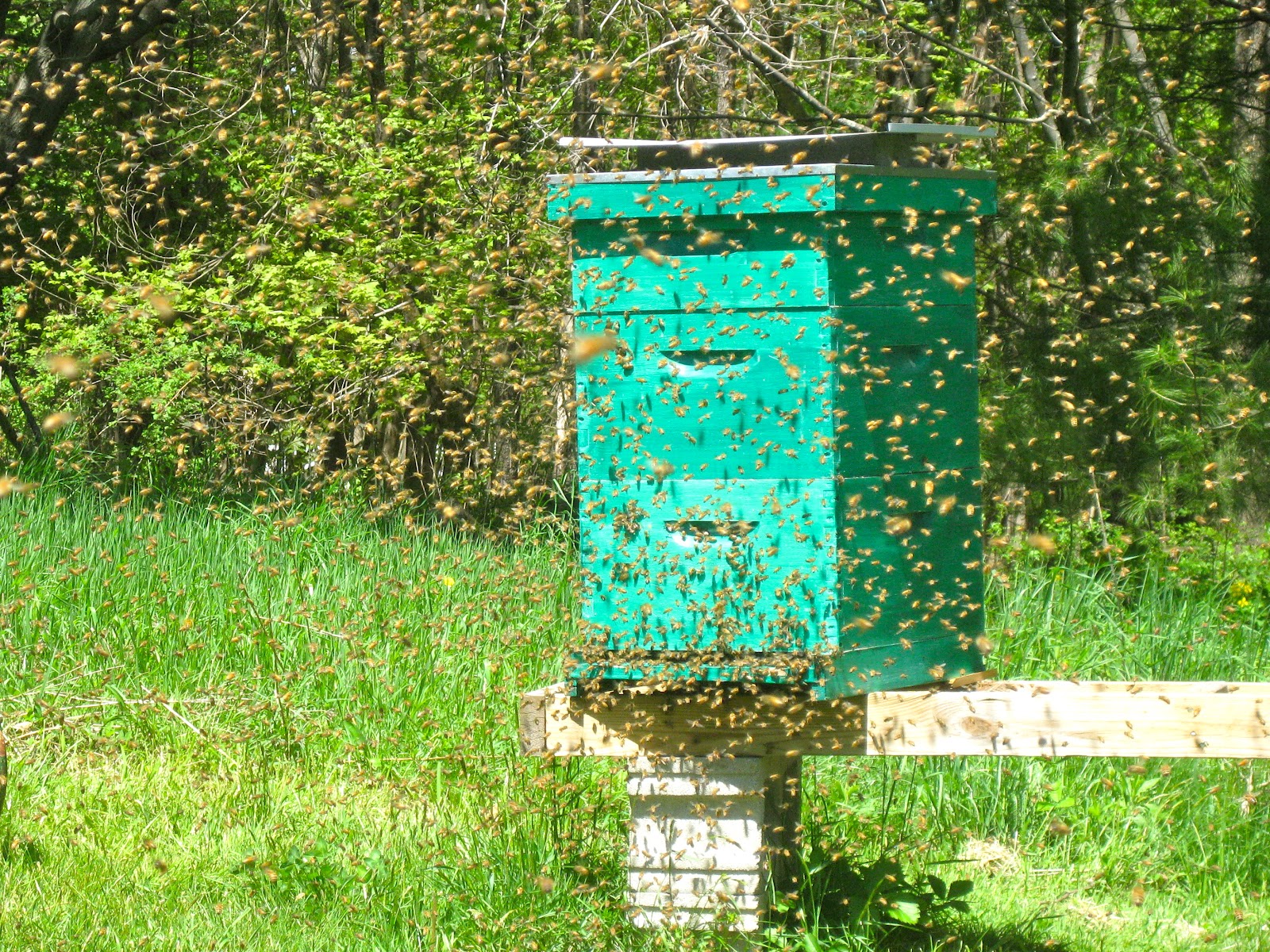
Sally's hive has been cranking along this spring and we knew that early swarming was a real possibility. We checked them out last weekend found the brood box riddled with queen cells. Were we already too late? As a last ditch swarm control measure, Kerstin and I scraped off about a 15 or 16 queen cells from the top brood box before we saw virgin queens out and running around on the comb and realized we hadn't seen Sally anywhere. Figuring she had already swarmed without our knowledge and rather demoralized, we abandoned our efforts in swarm management and left the remaining queen cells to carry out what we assumed would be a quick succession. However, yesterday morning we looked out the window and noticed a glittery movement around the hive. We all raced outside with camera in hand and witnessed tens of thousands of bees slowly circling the hive. I was determined to follow them and catch the swarm, but they punked us again. Instead of moving en masse to some nearby bush or branch, they swirled around a while, gathered in patches on a nearby bench, chair and the front porch of the hive and then slowly dissipated. I was completely devastated because this is not how bees are supposed to swarm, according to our books. Thinking they might have moved in a sneaky trickle to their swarm location to avoid detection, I walked the perimeter of our property looking for masses of bees, but couldn't find anything and eventually gave up. I was working in the garden a few hours later when I heard a loud buzzing behind me and lo, bees were once again spilling out of the hive and filled the air.  This time they gathered above the hive for a few minutes and then slowly made their way together towards the field (finally, doing something by the book!).


(The video quality is pretty poor after compression during the upload, but if you squint, you can make out the thousands of bees that fill the air here).

Our jubilation at watching the swarm move quickly subsided when the reality of their resting spot finally hit us.  They settled on a white pine branch at the edge of our field about 25 feet high. We left them alone for a few hours to plot our capture strategy. This being our first swarm capture attempt, we had to consult bee books for techniques and tips. Our go-to guide is The Backyard Beekeeper, mostly because there are lots of pictures and it's really easy to thumb through and find what you're looking for. At the top of the "Catching Swarms" chapter in the book was the following disclaimer: "Swarms that are very high in trees are seldom worth the risk of wobbly ladders and precarious positions. Safety is paramount here. A 6' stepladder is as high as you should go ... even then, you should only go halfway up." Pish, said we. Kerstin got out his 16' ladder and shored it up on bricks and cinderblocks. Then he placed a tarp under the swarm to catch any bees that may drop and we prepared an empty bee box with 3 frames placed at the edges and a screen bottom. I made some sugar syrup for misting the bees (this prevents them from flying and distracts them because they have to take some time away from being pissed off at you to clean themselves off.)

We made our move in the early evening as the sun was low in the sky and the bees were tightly clustered. Kerstin scaled the ladder and fashioned an old apple picker with a wire hook at the end to hook the branch and draw it down to low enough to grasp. He got through the branch with big loppers OK, but the weight of the branch caught Kerstin off guard and it snapped down, releasing about half the swarm in a shower down on the tarp we'd placed below. There were also plenty that didn't get hit with the mist of syrup that had taken flight instead. We feared all was lost, but there was still a good number of bees left in the cluster that remained on the branch, so Kerstin took it down and shook it smartly into the box. We put the lid on it and left the entrance open so that the bees could come and go. If the queen was in the box, so say the books, then the separated workers will sniff her out and join her in the box. If not, then the bees in the box would exit shortly and the swarm would regroup around the queen at another location. To our great relief, the bees did the former and were all tucked away in their new box by sundown. We moved them to their new location, gave them some food and they've taken to this hive beautifully. Best of all, lovely queen Sally didn't abandon us! We only had 1 hive a week ago, and now we have 4. I think we've really earned our beekeeping stripes with this experience.