Born today at 10.51am
9lbs, 3.6 oz
21.5 inches
head = 13.5 inches
No name yet.
More soon
August 14, 2012

August 8, 2012
Summer Swarm
The bees did it to us again!
 This time it was the Ponyo colony that swarmed (Alden named it after the movie he loves so much). Sometime about two weeks ago Queen Ponyo decided to take half the colony and swarm. We noticed a decline in productivity (bees flying in and out) but were busy doing other things so we didn't check it out. Needless to say we were unable to retrieve the swarm like we did earlier this year with Queen Sally.
Today we opened up the hive and saw some queen cells that were empty... so a new queen hatched and is now (hopefully) running the colony. We could not find the queen so we will have to check back in a few weeks and see if there are babies. If so, this is merely an unfortunate population dip that will hopefully not effect the colony preparing for winter. If there are no babies then there is no queen and the colony is doomed... Maybe we could merge the remaining workers with another colony, but that is about it. It is too late in the season to re-queen.


Today we opened up the hive and saw some queen cells that were empty... so a new queen hatched and is now (hopefully) running the colony. We could not find the queen so we will have to check back in a few weeks and see if there are babies. If so, this is merely an unfortunate population dip that will hopefully not effect the colony preparing for winter. If there are no babies then there is no queen and the colony is doomed... Maybe we could merge the remaining workers with another colony, but that is about it. It is too late in the season to re-queen.

August 3, 2012
Add one cat to our trapped animal count

August 2, 2012
Japanese beetle belt
"This is my safety Japanese beetle belt that saves me from being creepy"
 Hurray for creative play!
(safety Japanese beetle belt = BBQ tongs)

(safety Japanese beetle belt = BBQ tongs)
July 30, 2012
2 More Woodchucks, 2 New Skunks



July 15, 2012
First Honey Harvest


This is what we got after only a few minutes after the fume board was installed. While the smell really drove the poor bees nuts, unfortunately it didn't really clear them off the honey frames as well as we'd expected, so we gave up after the first attempt. Kerstin ended up employing the brush method (number 3) for the remaining frames.


Alden also spotted this amazing caterpillar on a grape leaf. We don't know who it is yet, but it was something none of us had ever seen before. It would attach its tail to the midrib of the leaf and when touched, it would lash around quickly, as if it were pretending to be a snake. It also had a really odd-looking raised, shiny marking that looked like a googly eyeball on its tail. If anyone knows what this creature is called, we'd sure appreciate an ID. UPDATE: It's an Abbott's Sphinx month larva.


July 9, 2012
Alden Theme Song
Alden has taken to including theme music into much of what he does these days. Here he is appreciating the snails and ants he put in his bug-jar.
July 8, 2012
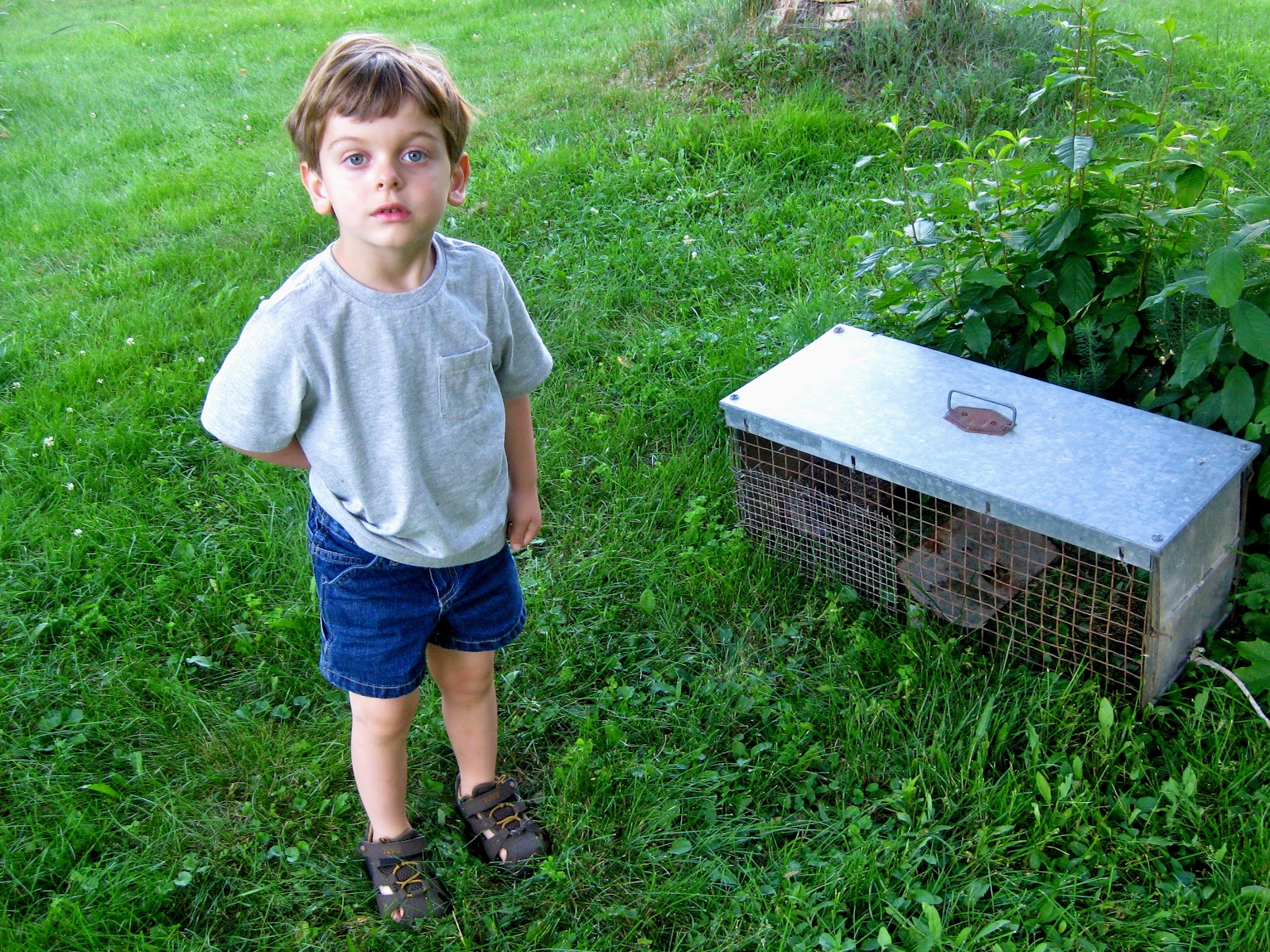
3 Groundhogs in three days!
The groundhogs just keep on coming! It seems like they are late in arriving this year.


July 2, 2012
Bee Check
We checked out our bees today. We have been much less vigilant than last year and I think the bees are happier for that. The less we poke around the more work they can get done.
 We have four hives now and each colony has its own personality, it is quite fascinating.
Beige hive = extremely hard working but a little cranky
Grey hive = medium hard working and very mellow
Green hive = medium hard working medium mellow
Purple hive = hard working and medium mellow
 We were mostly looking for how much honey might be coming our way this year... maybe 40lbs so far. we plan to harvest sometime soon and then do a pest treatment. Mites are supposed to be really bad this year, and even though we have not been keeping track of pest we want to be on the safe side.
 So the plan is to harvest what we have in the next week or two, treat for pests, and then put the honey supers back on for a possible second harvest in the fall.

Beige hive = extremely hard working but a little cranky
Grey hive = medium hard working and very mellow
Green hive = medium hard working medium mellow
Purple hive = hard working and medium mellow


July 1, 2012


Subscribe to:
Posts (Atom)